Building opportunity: How the Anti-Displacement Community Prosperity Program (ACPP) Board is investing in small businesses, community development
When the Anti-Displacement Community Prosperity Program (ACPP) Board launched its inaugural $2 million funding phase, community-led priorities were at the forefront. Among the program’s four qualifying purposes, the real estate pillar plays a crucial role in strengthening community ownership, ensuring long-term affordability, and preventing displacement in neighborhoods along the Blue Line Extension Corridor.
Two grantees, Kirk’s Café and Land Bank Twin Cities, offer vivid examples of how real estate investments can protect cultural identity, promote economic opportunity, and build place-based stability for residents and small businesses.
The ACPP Board was created by state legislation to implement the Anti-Displacement Community Prosperity Program, a community-centered initiative to support neighborhoods at risk of displacement along the Blue Line Extension Corridor.
The legislation names the 26-member Anti-Displacement Work Group that led the development of an anti-displacement recommendations report as the board to oversee ACPP. The group is made up of community leaders, local business owners, the philanthropic community, government agencies, and people who have lived experience of displacement.
The communities along the corridor include residents and businesses in Minneapolis, Robbinsdale, Crystal and Brooklyn Park. The corridor includes both the previous route alignment considered for the Blue Line Extension and the current route.
Kirk’s Café: Revitalizing a community anchor on Glenwood
Kirk’s Café received $175,000 to renovate a long vacant building at 1830 Glenwood Ave. N., transforming it into a cultural café, co-working hub, and small business incubator honoring the legacy of North Side artist and activist Kirk Washington Jr.
The inspiration for Kirk’s Café is deeply rooted in the Harrison neighborhood and Denetrick Powers’ personal journey.
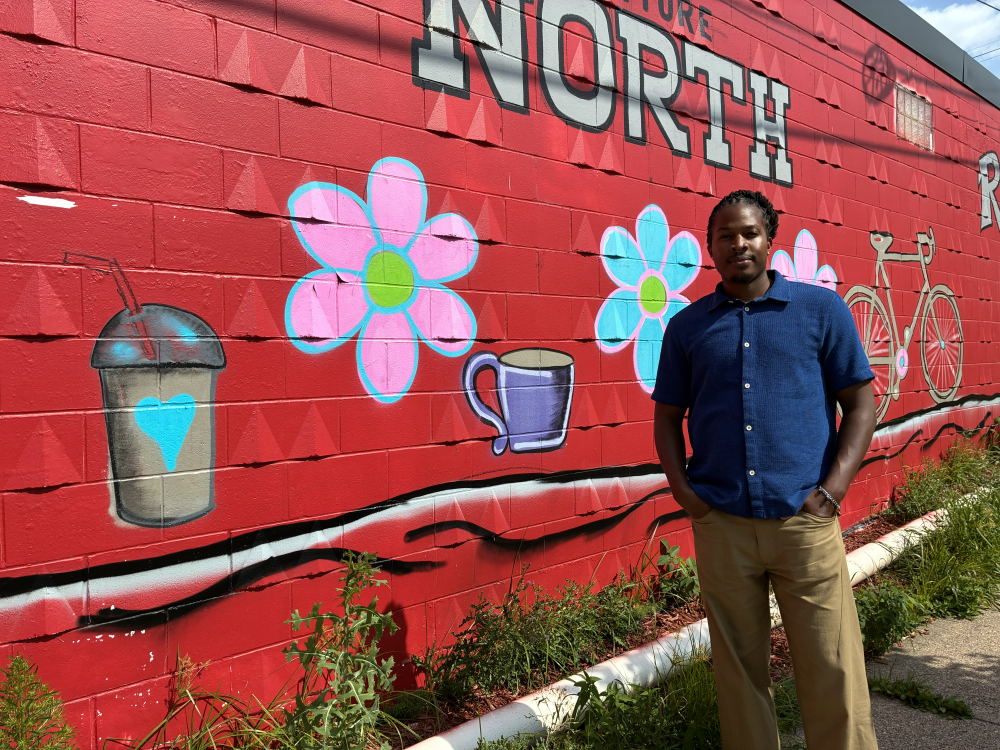 Denetrick Powers outside the future Kirk’s Café location on Glenwood Avenue.
“I grew up in the Harrison neighborhood, attended North High, and lived near Glenwood and Logan for several years. My family was involved with Redeemer Lutheran Church, and I participated in their youth programs. The inspiration for the cafe came from a song written by a fellow youth leader, which led to the creation of Venture North, a coffee and bike shop,” he said. “After college, I proposed managing the coffee shop, which was at risk of closing due to inconsistent management. My degree in business, marketing, and retail merchandising helped me take on this role, and that’s where my passion for coffee and its culture began.”
Coffee shops, Denetrick notes, are unique spaces that break down social boundaries: “In Harrison, they brought together people from all backgrounds: homeowners, neighbors, organizational leaders, and elected officials. It became a place for community connection and relationship-building.”
When the nonprofit Redeemer Center for Life considered selling the property, Denetrick saw both sentimental and market value in opening a coffee shop.
“The building sat vacant for three years before I purchased it in 2025. Naming it after Kirk Washington Jr., a neighborhood leader and mentor, honors his legacy and leadership in North Minneapolis,” he said.
His vision for Kirk’s Café is clear: “I see Kirk’s Cafe as a ‘third space’— a place for people to gather, enjoy arts and cultural programming, and connect with other small businesses. I want it to anchor the Harrison neighborhood and foster connections across North Minneapolis, especially as development and transit projects progress. Preserving the cultural heritage of the area is central to the cafe’s mission.”
The impact of ACPP funding has been transformative.
“The ACPP funds were crucial. Without them, the project wouldn’t have been possible due to construction costs,” he said. “The grant helped cover these expenses. The funds are enabling us to get operational, build out the kitchen space, and move toward opening.”
Denetrick is aiming for a fall opening, ideally mid to late October.
Land Bank Twin Cities: Strategic acquisition for community-led development
Land Bank Twin Cities received $200,000 to redevelop underutilized properties into community-centered development at 1300 West Broadway Ave. N.
Land Bank is a social impact real estate and finance intermediary that aligns land, capital, and community priorities to prevent displacement.
“Our program works with mission-driven partners and projects that have real estate needs but lack the resources or financing when opportunities arise,” said Garrett Peterson, program manager of strategic acquisition at Land Bank Twin Cities. “We acquire and temporarily hold properties on their behalf, entering into resale agreements to give them time to assemble resources and move forward. Essentially, we act as an intermediary to preserve opportunities for community-led development.”
The acquisition of 1300 West Broadway was made possible by combining ACPP awards: Land Bank Twin Cities received $200,000, and Riverfront Development Partners received $150,000. Together, these funds covered a substantial portion of the $550,000 purchase price, enabling the assembly of the site with another parcel at 2015 Girard Avenue North.
“The ACPP funding acts as a pass-through subsidy, directly supporting the project and its community-led goals. When we buy and hold properties, we pass them along to our resale partner at the purchase price plus any project costs and fees. Thanks to the ACPP funding, our resale agreement includes a $350,000 subsidy, which stays with the project rather than the organization.”
During the holding period, Land Bank Twin Cities expedites pre-development work, such as environmental remediation and demolition. Currently, the site is being prepared by demolishing a dilapidated building, with the ultimate vision for the Resolute project to be realized by Riverfront Development Partners.
The proposed Resolute development calls for a 14,000-square-foot, two-story commercial development at 1300 West Broadway Avenue designed to support small businesses, including a co-working hub for entrepreneurs, beauty and wellness services and mental health services.
Learn more about other projects funded by the ACPP Board.
Building opportunity: How the Anti-Displacement Community Prosperity Program (ACPP) Board is investing in small businesses, community development
When the Anti-Displacement Community Prosperity Program (ACPP) Board launched its inaugural $2 million funding phase, community-led priorities were at the forefront. Among the program’s four qualifying purposes, the real estate pillar plays a crucial role in strengthening community ownership, ensuring long-term affordability, and preventing displacement in neighborhoods along the Blue Line Extension Corridor.
Two grantees, Kirk’s Café and Land Bank Twin Cities, offer vivid examples of how real estate investments can protect cultural identity, promote economic opportunity, and build place-based stability for residents and small businesses.
The ACPP Board was created by state legislation to implement the Anti-Displacement Community Prosperity Program, a community-centered initiative to support neighborhoods at risk of displacement along the Blue Line Extension Corridor.
The legislation names the 26-member Anti-Displacement Work Group that led the development of an anti-displacement recommendations report as the board to oversee ACPP. The group is made up of community leaders, local business owners, the philanthropic community, government agencies, and people who have lived experience of displacement.
The communities along the corridor include residents and businesses in Minneapolis, Robbinsdale, Crystal and Brooklyn Park. The corridor includes both the previous route alignment considered for the Blue Line Extension and the current route.
Kirk’s Café: Revitalizing a community anchor on Glenwood
Kirk’s Café received $175,000 to renovate a long vacant building at 1830 Glenwood Ave. N., transforming it into a cultural café, co-working hub, and small business incubator honoring the legacy of North Side artist and activist Kirk Washington Jr.
The inspiration for Kirk’s Café is deeply rooted in the Harrison neighborhood and Denetrick Powers’ personal journey.
Denetrick Powers outside the future Kirk’s Café location on Glenwood Avenue.
“I grew up in the Harrison neighborhood, attended North High, and lived near Glenwood and Logan for several years. My family was involved with Redeemer Lutheran Church, and I participated in their youth programs. The inspiration for the cafe came from a song written by a fellow youth leader, which led to the creation of Venture North, a coffee and bike shop,” he said. “After college, I proposed managing the coffee shop, which was at risk of closing due to inconsistent management. My degree in business, marketing, and retail merchandising helped me take on this role, and that’s where my passion for coffee and its culture began.”
Coffee shops, Denetrick notes, are unique spaces that break down social boundaries: “In Harrison, they brought together people from all backgrounds: homeowners, neighbors, organizational leaders, and elected officials. It became a place for community connection and relationship-building.”
When the nonprofit Redeemer Center for Life considered selling the property, Denetrick saw both sentimental and market value in opening a coffee shop.
“The building sat vacant for three years before I purchased it in 2025. Naming it after Kirk Washington Jr., a neighborhood leader and mentor, honors his legacy and leadership in North Minneapolis,” he said.
His vision for Kirk’s Café is clear: “I see Kirk’s Cafe as a ‘third space’— a place for people to gather, enjoy arts and cultural programming, and connect with other small businesses. I want it to anchor the Harrison neighborhood and foster connections across North Minneapolis, especially as development and transit projects progress. Preserving the cultural heritage of the area is central to the cafe’s mission.”
The impact of ACPP funding has been transformative.
“The ACPP funds were crucial. Without them, the project wouldn’t have been possible due to construction costs,” he said. “The grant helped cover these expenses. The funds are enabling us to get operational, build out the kitchen space, and move toward opening.”
Denetrick is aiming for a fall opening, ideally mid to late October.
Land Bank Twin Cities: Strategic acquisition for community-led development
Land Bank Twin Cities received $200,000 to redevelop underutilized properties into community-centered development at 1300 West Broadway Ave. N.
Land Bank is a social impact real estate and finance intermediary that aligns land, capital, and community priorities to prevent displacement.
“Our program works with mission-driven partners and projects that have real estate needs but lack the resources or financing when opportunities arise,” said Garrett Peterson, program manager of strategic acquisition at Land Bank Twin Cities. “We acquire and temporarily hold properties on their behalf, entering into resale agreements to give them time to assemble resources and move forward. Essentially, we act as an intermediary to preserve opportunities for community-led development.”
The acquisition of 1300 West Broadway was made possible by combining ACPP awards: Land Bank Twin Cities received $200,000, and Riverfront Development Partners received $150,000. Together, these funds covered a substantial portion of the $550,000 purchase price, enabling the assembly of the site with another parcel at 2015 Girard Avenue North.
“The ACPP funding acts as a pass-through subsidy, directly supporting the project and its community-led goals. When we buy and hold properties, we pass them along to our resale partner at the purchase price plus any project costs and fees. Thanks to the ACPP funding, our resale agreement includes a $350,000 subsidy, which stays with the project rather than the organization.”
During the holding period, Land Bank Twin Cities expedites pre-development work, such as environmental remediation and demolition. Currently, the site is being prepared by demolishing a dilapidated building, with the ultimate vision for the Resolute project to be realized by Riverfront Development Partners.
The proposed Resolute development calls for a 14,000-square-foot, two-story commercial development at 1300 West Broadway Avenue designed to support small businesses, including a co-working hub for entrepreneurs, beauty and wellness services and mental health services.
Learn more about other projects funded by the ACPP Board.
